
At ConnectLive 2026, iManage CEO Neil Araujo announced a fundamental evolution of the iManage platform as a reimagined, contextual foundation for AI-era knowledge work.
This evolution extends the existing iManage capabilities and leverages the existing cloud infrastructure that customers already trust for performance, reliability, and scale. The argument is simple and pointed. AI is only as trustworthy as the knowledge it draws on. And, while most organizations are sitting on decades of institutional knowledge, many find it isn’t structured, enriched, or connected for the use cases AI now presents. iManage is working to change that. Because once knowledge-intensive organizations have the right foundation in place, the shift to AI quickly becomes a compounding advantage.
The shift that changed everything
Thirty years ago, document management was a clear-cut process: capture the work, store it safely, retrieve it when needed. There was a shift to the cloud, but the need for secure, matter-centric document and email storage and efficient access remained straightforward. Then generative AI brought the all up artificial intelligence conversation, which had existed for decades, out of the labs and into the mainstream light of day —by making it accessible to everyone. Its ease of use promised greater productivity, but its capabilities quickly accelerated beyond most people’s expectations, and that promise quickly evolved. Agentic AI acts on behalf of professionals to execute tasks, not just support them.
We are in a period of huge transition, and you can feel it.” — Neil Araujo, CEO at iManage
He acknowledged that in the three years since generative AI arrived that the volume and velocity of inbound work have increased, not decreased. That the anxiety in the market is real. And that organizations not yet using these tools are not just missing an opportunity — they are falling behind.
The announcement that followed was the answer to that anxiety. At ConnectLive 2026 iManage, Araujo revealed the next phase of its platform evolution: the governed, reimagined foundation for AI-era knowledge work. Not a button in a UI. Not a feature release. A platform reconceptualized for an agentic AI future, with significant architectural consequences for every organization that depends on expert knowledge to deliver client outcomes.
Turning work into lasting value
Every organization in a knowledge-intensive sector shares the same structural problem, even if few have named it clearly. Work happens. Matters open and close. Relationships develop, judgments are made, positions are taken.
The matter is how work begins, unfolds, and ends. It is a story. When matters close, all that judgment goes into the archive. Filed, forgotten, and the story ends.” — Neil Araujo, CEO at iManage
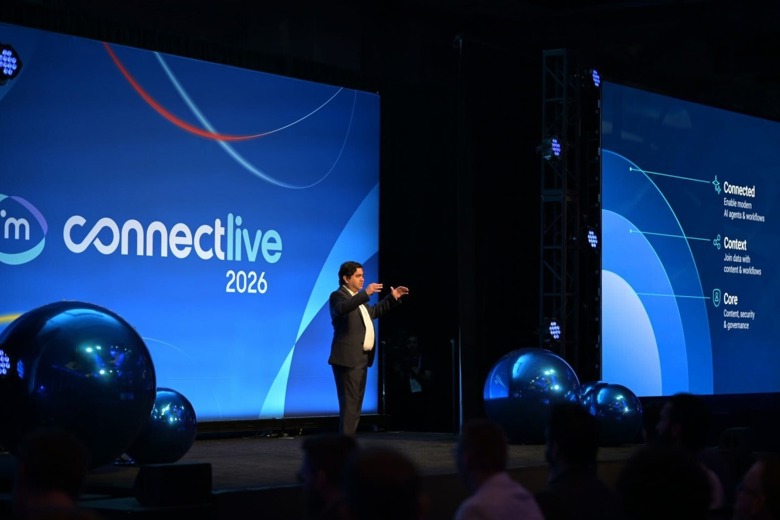
The reason was simply that, for decades, getting accessible content into the matter was harder than not getting it in. So matters were often thinner than they could have been. Content was often less accessible. And thin matters with inaccessible content produce thin AI outputs.
iManage has changed both sides of that equation, argues Araujo. The platform now makes it easier than ever to capture more content into the matter — and, critically, has changed the incentive to do so. The more complete the matter, the better every AI tool that draws on it performs.
The logic compounds: “We are not storing and forgetting anymore. We are storing, contextualizing, and understanding.” — Neil Araujo, CEO at iManage
In his platform session that followed, Chief Product Officer Shawn Misquitta put the mechanics plainly:
What we are doing here is much like a refinery,” he said. “What you had was very crude data — we have to turn it into refined petroleum.” — Shawn Misquitta, Chief Product Officer at iManage
That refining process — classification, enrichment, metadata extraction, expert signals — is what transforms decades of filed work from an archive into an active, searchable, knowledge foundation.
The longer you are on iManage, the stronger [and more refined] it gets. These benefits compound.” — Neil Araujo, CEO at iManage
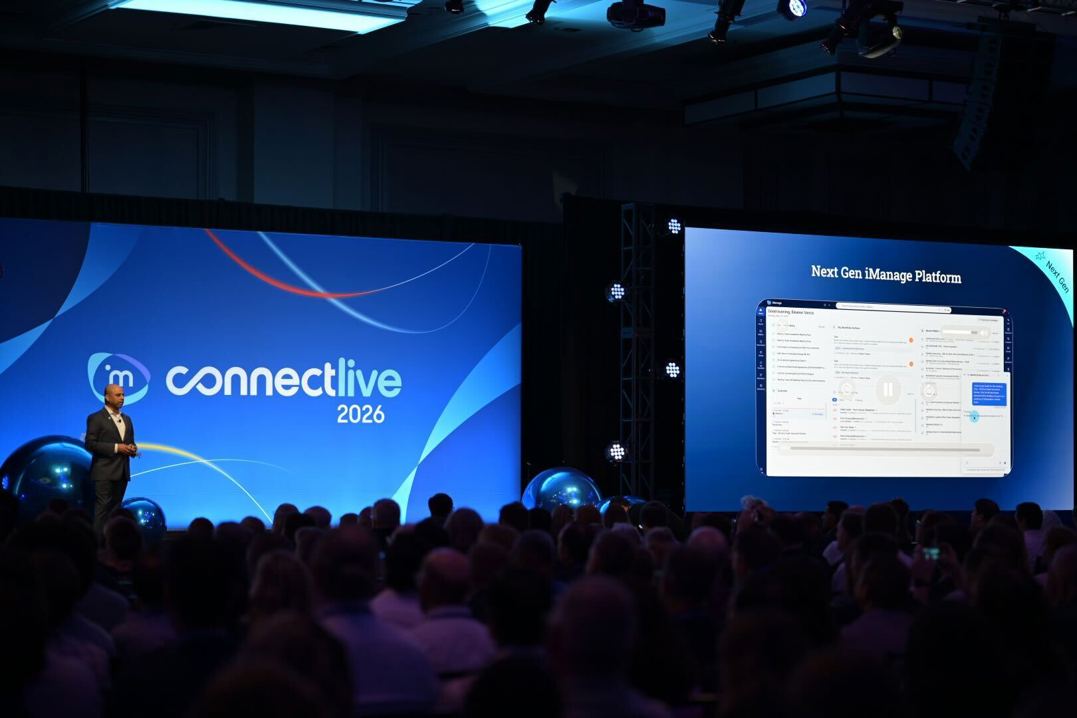
The keynote illustrated this with scenarios built around what becomes possible when AI knows an organization’s work as well as the professionals who did it. When a senior partner retires, every matter they touched — the negotiating instincts, the risk calls, the client relationships — is structured, connected, and available.
The firm inherits the knowledge. Not as files, but as understanding.” — Neil Araujo, CEO at iManage
A general counsel asks about regulatory exposure. The AI searches the firm’s own matters — actual positions taken, actual advice given — and returns an answer that is cited, auditable, and defensible. Not a guess from the open web. The firm’s own position.
Experts decide, systems support
No organization serving the legal industry in 2026 can avoid the question of AI governance. Araujo addresses it head-on. The proliferation of agentic AI changes the risk calculus entirely, he argues, because they move faster than the governance frameworks most organizations have in place. According to recently published iManage research, nearly one-third of organizations have already experienced a policy-impacting incident tied to unregulated AI tools, while nearly 30 percent have delayed AI adoption outright because of security concerns.
Misquitta expressed the scale of the problem most sharply. AI agents, he told the room, will hit an organization’s knowledge core significantly harder than any human user. They are, in his words, “virtual users roaming around in your system” — and they will soon outnumber the professionals they serve.
Jan Van Hoecke (iManage) emphasized the risk:
Most failures in agent systems are not reasoning failures. The weakest link is what we feed into the agent — and what we let it do.” — Jan Van Hoecke, Head of AI at iManage
In a single observation, Van Hoecke reframes the AI platform question entirely. It is not a question of choosing the right model or agent. It’s a question of having the right context and governance. This argument is made by iManage across the keynotes, as well as its resolution.
Central to this reimagined platform is what iManage calls the context fabric — the layer that gives AI access to everything an organization knows, but only what each user or agent is permitted to reach. It provides signals that enable models to reason and act on that knowledge at the right moment, for the right person, with the right understanding of what that knowledge represents.
As agents begin to populate an organization’s iManage environment, iManage Security Policy Manager extends its permission structures and governance to their activity. The human professional remains the decision-maker. The system ensures that what it surfaces has been structured, governed, and made defensible before it reaches them.
Governance ensures that what AI does for you is within the permission boundary that you or that agent is enabled for, and that the work is audited and defensible.” — Neil Araujo, CEO at iManage
The point is not that AI replaces the expert. It is that AI, without the right foundation, makes the expert less effective — and increases the risk they carry. The iManage platform is designed so that the expert who uses it can trust what the AI surfaces.
Connected by design
Legal firms may run Harvey alongside iManage. Corporate legal departments may run Microsoft Copilot agents in tandem with iManage. The question is not whether AI tools will multiply (they will) but whether the knowledge base they all draw from will be governed or ungoverned, coherent or fragmented.
Your content stays in the core. The ecosystem plugs into it. Two hundred-plus partners, all drawing from the same governed knowledge base. Intelligence flows through your ecosystem. Governance as a foundation.” — Neil Araujo, CEO at iManage
Araujo was direct about the scale of what is coming: the number of agents and applications that need to connect to an organization’s content is growing fast. As agentic workflows become more common, the complexity is only increasing. The iManage MCP Server — the open-protocol connection layer for iManage Cloud — replaces the sprawl of custom integrations with a single standardized connection, so every AI application reaches the same governed knowledge base.
For organizations with decades of matter history, the implication is that the compound effect described above multiplies across all connected tools.
What this means for organizations building their AI strategy now
Araujo said the gap between AI pilots and AI at scale is almost entirely a foundation problem.
The organizations that have made that connection are already pulling ahead.” — Neil Araujo, CEO at iManage
The numbers bear that out: the iManage Knowledge Work Benchmark Report 2026 found that 85 percent of organizations are already piloting or implementing AI, but only 17 percent have integrated it into daily operations. Organizations running AI experiments on disparate, unenriched, unconnected data will keep getting experiment-quality results. Organizations with a knowledge foundation in place will compound their advantage with every matter that closes, every document that is enriched, every agent they use to draw on a governed source. What the foundation delivers is unambiguous: organizations with higher knowledge work maturity are nearly twice as likely to report year-over-year revenue growth as their less mature peers.
The gap between those two things is where most organizations are stuck right now. The foundation is what closes it.” — Neil Araujo, CEO at iManage
That foundation is the iManage platform announced at ConnectLive 2026. And Misquitta’s summary from the stage captures what that foundation actually does in practice: “We have really brought AI into your data — versus you having to take your data to AI.” The content stays where it has always been, governed and structured.
Our world will be human-led, but agent-supported, agent-assisted, and knowledge-driven.” — Neil Araujo, CEO at iManage
It’s clear that after 30+ years iManage is still Making Knowledge Work™ — and that ConnectLive 2026 has brought tangible new meaning to the company’s brand promise; the reimagined iManage platform provides the governed knowledge layer that makes AI trustworthy enough to act on.
Explore the iManage platform — and see what the agentic foundation looks like in practice in our forthcoming webinar.
Former journalist turned tech content strategist. James has spent his career finding the stories that connect — and making sure they reach the people who need to hear them.
Discover more from iManage
Reflections from ILTACON 2025: A visionary future for legal innovation
Laura Wenzel reflects on ILTACON 2025’s keynote by Reena SenGupta, spotlighting a bold new era in legal innovation driven by AI, productization, and human-centered design.
Insights from the 2024 LTH-EY GenAI and Data Enablement Conference
Explore the transformative potential of generative AI in the legal sector.
The Next-gen iManage Platform: The Foundation for Knowledge Work in an Agentic World
The next-gen iManage platform is generally available. See how AI built into the flow of work runs on the governed foundation your organization already trusts