Successful legal AI starts before the first prompt

At our recent event, Scaling Your Legal Department with AI, hosted by iManage at the Microsoft Innovation Center in partnership with Harvey and Microsoft, legal operations leaders from banking, asset management/PE, insurance, pharma, and tech gathered to discuss a challenge many in house legal teams are now facing: how to move from AI ambitions to everyday practice.
The conversation focused on the structural decisions required to scale AI successfully, including what legal teams should own, automate, delegate, or offload, and how platform, knowledge, governance, and legal reasoning layers come together in real-world deployments.
Throughout the discussion, participants shared practical lessons including how they are measuring value, managing governance, enabling adoption, and reducing risk. While the use cases varied, a common theme emerged: legal teams realize the greatest value from AI when legal reasoning is connected directly to trusted institutional knowledge.
The real challenge isn't adoption. It's access to institutional knowledge
As in-house legal teams move from piloting AI to deploying it, the challenge has become the underlying data the AI is grounded in. The necessary information exists but is often buried in decades of irrelevant data.
The conversation has moved beyond which AI to use to how to ensure that the useful and necessary data is discoverable, trusted, and applied within the context of a legal matter or question. Getting this right is critical to delivering impactful AI outcomes.
At the event, several legal leaders noted that the value of AI increased significantly when it could draw directly from governed institutional knowledge like precedents and history.
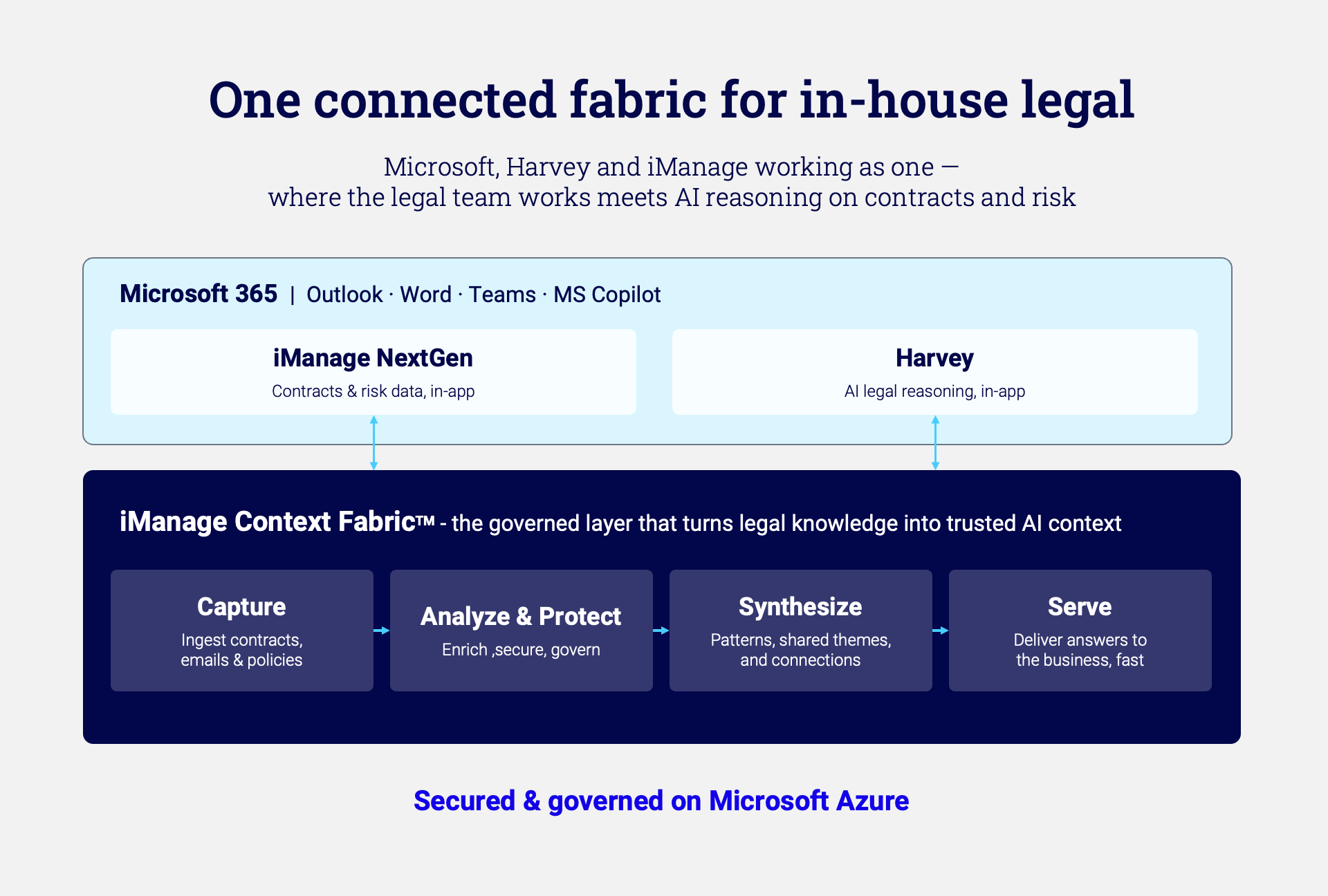
With iManage and Harvey together, teams can connect their legal reasoning agent to their trusted organizational knowledge and context rather than starting from scratch each time or manually assembling documents.
This delivers a meaningful opportunity for in-house teams to not only add AI to legal work, but to reduce the distance between a legal question and the team’s collective knowledge in the iManage platform. Harvey can generate more reliable legal analysis when it can access not just documents but the context that surrounds them.
Governance is what makes AI enterprise-ready
Governance has quickly become a top priority. With legal teams responsible for managing an organization’s most sensitive information, they must balance the value of AI with adherence to strict regulatory requirements.
Several attendees emphasized the importance of information architecture, retention policies, security controls, and governance frameworks as a first step in any AI initiative. And governance is not simply about compliance — it is about confidence that holds up to board scrutiny.
General counsel needs confidence that their lawyers are working with the correct documents, the latest versions, the appropriate matter context, and information that respects access controls, audit needs, and regulatory obligations.
As more lawyers have started powering legal analysis and drafting in Harvey, their legal ops and IT teams have elevated their governance, with iManage establishing the necessary guardrails and policies to deploy and scale agents responsibly.
The result is lawyers moving more seamlessly from question to analysis to work product, while maintaining the security, governance, collaboration, and matter context that legal work demands.
The ROI of trusted context + AI-driven legal reasoning
Reduced outside counsel spend was repeatedly highlighted as one of the clearest business cases for AI. Better access to institutional knowledge and precedents, paired with stronger AI legal reasoning, enable legal leaders to keep more work in-house.
Projects that once would've been outsourced now stay internal, delivering direct cost-savings. Others saw tangible results from faster onboarding, knowledge reuse, and increased workload capacity without adding headcount.
Importantly, participants argued that the value of AI cannot be measured by time savings alone. The shift of lawyer time spent from low- to high-value activities and risk reduction rise as top value drivers.
As legal teams see AI taking the routine work off their desks —like redlining, drafting, and research — they are freed up to own judgment, risk advisory, and business partnership.
Additionally, when legal teams work from governed matter information without moving documents across disconnected systems, they reduce the risks associated with duplicate document copies, unmanaged workflows, version confusion, and sensitive information leaving approved environments.
Efficiency remains an important outcome. But many legal leaders are increasingly focused on something larger: creating a more trusted, repeatable, and scalable way to apply institutional knowledge to legal work.
Key takeaways for legal leaders
Drawing from the discussion, several practical recommendations emerged for organizations looking to advance their AI initiatives:
Start with business outcomes. The most successful programs begin with clear objectives such as reducing outside counsel spend, improving contract turnaround, increasing team capacity, or making institutional knowledge more accessible.
Treat governance as the foundation. Several attendees described governance as "step zero" for AI adoption. Information architecture, security controls, ethical walls, metadata, and retention policies should be established before scaling AI. iManage embeds these controls into the knowledge platform rather than bolting them on later.
Ground AI in governed institutional knowledge. Attendees repeatedly noted that AI delivers better outcomes when it can access trusted matter context, precedent, and organizational knowledge. Combining Harvey's legal reasoning capabilities with the governed knowledge foundation of iManage helps ensure legal work is informed by the legal team’s collective expertise.
Keep knowledge and work connected. Through MCP, Harvey can securely access content managed in iManage, allowing lawyers to move from question to analysis to work product without manually moving documents between systems. This preserves context, maintains version control, and reduces governance risk.
Measure success beyond efficiency. Legal leaders pointed to improved quality, reduced risk, stronger knowledge reuse, faster onboarding, and the ability to keep more work in-house as some of the most meaningful indicators of value.
Keep human judgment at the center. AI can accelerate legal work, but lawyers remain responsible for applying business context, precedent, experience, and professional judgment to every decision.
Building the foundation for what's next
The strongest message from legal leaders actively deploying these technologies was that AI delivers the greatest value when legal reasoning is connected directly to governed institutional knowledge. Attendees repeatedly highlighted the importance of combining the trusted repository of documents, precedent, permissions, and organizational knowledge found in the iManage platform with Harvey's agentic capabilities that help analyze, reason, draft, and execute legal work.
Organizations that pair Harvey's legal reasoning capabilities with the governed knowledge foundation of iManage are not simply deploying AI. They are creating an environment where institutional expertise becomes easier to access, apply, and scale across the legal department.
For organizations seeking a governed way to scale AI, the lesson from legal leaders already putting these technologies into practice was clear: better legal outcomes require both intelligent reasoning and trusted legal knowledge.
Get in touch to learn more about how iManage and Harvey work together.
Ann Marie Lane
Senior Principal - Product MarketingAnn Marie Lane is Senior Principal - Product Marketing at iManage. She has extensive experience helping software companies to build their brand through strategy, storytelling, thought leadership, and demand.
Discover more from iManage
The pyramid is crumbling. Where do your juniors learn now?
AI is automating the work that taught junior professionals how to think. Firms that get this wrong may not notice until it’s too late. See what good looks like.
The quality of AI shouldn’t depend on who is asking
The quality of AI shouldn’t depend on who is asking. See how iManage tested its legal AI for bias, closed the gaps, and why the quiet failures matter most.
How iManage & Harvey help legal teams unlock the value of AI
Connect Harvey and iManage so legal teams can use AI on trusted knowledge, reduce friction, and maintain governance, permissions, and auditability.